Great King Who?

Around the time when I decided not to travel abroad any more, a friend of mine, a historian, called in to present me with a copy of a book recently published about a character called Verica, king of the Atrebates, one of the tribes associated with the White Horse of Uffington. It was in that book that I first read about Togidubnus. The author was a fan of this presumed son of Verica and, soon enough, so was I.
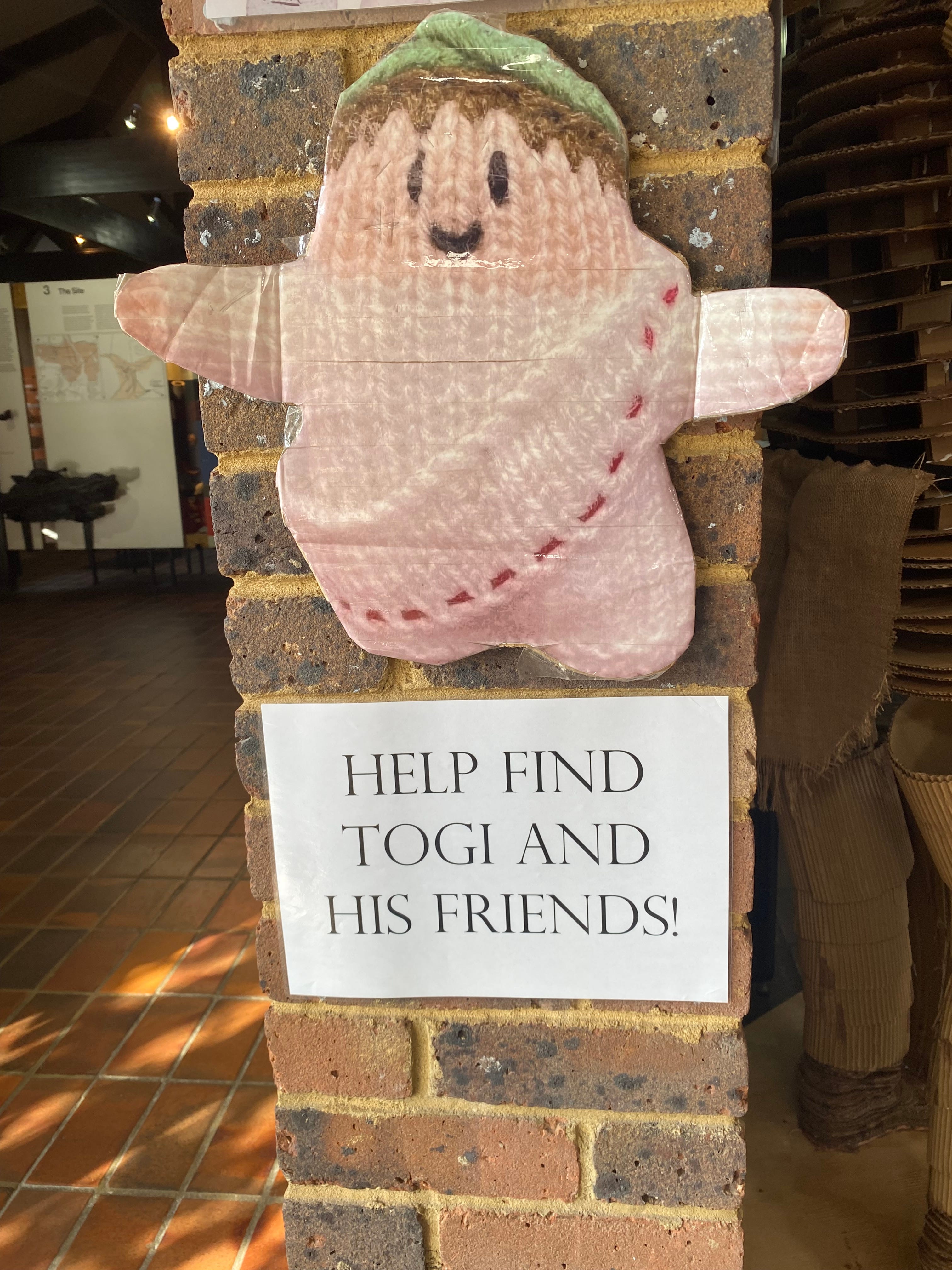
The title of Great King is usually associated with Alfred, king of Wessex, but it seems we had one before the Saxons arrived and that he is almost completely forgotten. His memory has been kept alive by Fishbourne Roman Palace, which it is thought that he built and lived in. He is celebrated in the museum with a knitted doll called ‘Togi’. (To check all the boxes for funding, museums seem to have turned into creches).
It’s a feature of the Roman occupation of four hundred years that the name of Roman gods, and Romans themselves, trip easily off our tongues, while we blink at the name of ancient Britons as at something strange and definitely unpronounceable. It took me awhile to be able to say Togidubnus but it’s no problem now.
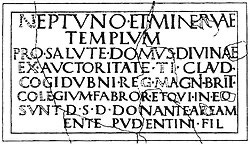
So who was this man? The facts are sparse. Tiberius Claudius Togidubnus gets a brief mention by Tacitus as an ally of Rome whose territory was greatly extended after the conquest. His name also occurs in a slab found in Chichester, a dedication stone for a temple. The inscription reads:
To Neptune and Minerva, for the welfare of the Divine House by the authority of Tiberius Claudius Togidubnus, great king of Britain, the guild of smiths and those therein gave this temple from their own resources, Pudens, son of Pudentinus, presenting the site.
And that’s it, folks. Thems the facts.
‘Great King of Britain’ — what a thrilling phrase! Not only was he a great king, but of Britain. Up until the arrival of the Romans, Britain had been a squabble of fractious, unneighbourly tribes, constantly at war with each other. Indeed, when the Atrebates had been driven out of their homelands, which stretched from the south coast to the Thames, and were encamped at Noviomagus (Chichester) between the devil and the deep blue sea, Verica fled to Rome to beseech Emperor Claudius to send an army to help him defeat his enemies, the Catuvellauni. That tribe, which held a large territory north of the Thames, was led by two brothers, one of whom was Caratacus. The man who became the famous resistance leader, whose name we do know and remember, actually caused the invasion.
It is entirely plausible that Verica would have sent his son to Rome as a ‘hostage’, not only as proof of his loyalty but also so that the boy might be educated in a way that was vital for future dealings with the Empire, that is, in Latin.
These days he’s marmite to historians. While some see him as great, others consider him a ‘collaborator’. Togidubnus would have been amused by this, since collaboration means to work together, and he could hardly deny that was true. He worked with both the Romans and the Britons to find a way to live together in peace.
Tiberius Claudius Togidubnus was a peacemaker.
The idea of hero in that age was a muscular brute of a man so brave, courageous and enraged that he felt no pain matter how gory his wounds in battle with his foe. The idea of king was much the same: the toughest guy in the tribe, buying loyalty with his treasure hoard, dealing with enemies in the time-honoured manner of bloody slaughter and getting drunk after victory.
Togidubnus came back from Rome to find himself, as the only surviving son of Verica, king of the Atrebates, but he had a wider vision of the world than the next dyke or hill fort. Educated in Latin, yes, and perhaps also in philosophy? At the time, the stoic Seneca was teaching in the forum. It is plausible that our man was a student there.
Plausible. When facts are so few, plausibility is the main guide in our speculations, whether they are the speculations of academics or novelists. Here was a man who, unlike Caratacus, saw that Britain’s chance of resisting the conquest were very small indeed. The tribes simply weren’t organised enough. Some groups, such as the Brigantes of Yorkshire, were federations, but there was no sense of one nation.
Tiberius Claudius Togidubnus — Great King of Britain. It would seem that, by the end of his long life, Togidubnus had achieved national unity of a kind. As ever, there is nothing like a common enemy to pull people together. There is no sense of this achievement being the result of warfare. He picked his careful way through the uprisings of Caratacus and Boudicca, a supreme diplomat able to achieve with words what others achieved with weapons.
He was a peacemaker.
This was, of course, the age of the man of peace. Togidubnus would have been about 10 at the time of the death of Jesus. For sure, he would not have met him, but would he have heard of him? Perhaps, but only as a resistance leader whose followers were causing trouble in Rome.
The crucifixion caused a ripple in the cosmos. You did not need to have heard or seen anything to be witness to a change in humanity. A certain grace descended on us. We passed from being a brutal species practising the survival of the fittest to one that had virtues such as compassion. If Togidubnus never heard of Jesus, he certainly knew of Seneca, but Stoicism, which teaches us to have control of our appetites and seek a happy life, isn’t that grace that emerges in the first century.
No doubt it has always been human nature to help others, even at the risk of one’s own life. Like the heroes of old, no pain is felt when running into a burning house or lifting a bus off someone who has been run over. Jesus said, ‘Greater love hath no man than to lay down his life for his friends.’ Far be it from me to argue with Jesus, but surely it’s an even greater love to lay down your life for strangers, or even enemies?
We have plenty of examples of that in our own times. The darker things get, the more examples there are.
Togidubnus, king of the Britons, this forgotten figure of our history, was what we might call a New Man. I think we can safely ascribe to him the creation of te culture called ‘Romano Britain’, neither fully Roman nor fully British but a fertile marriage of the two. It was a civilisation that lasted 400 years before it collapsed under the onslaught of those whose heroes, once again, were muscle-bound, fame-thirsty warriors.